← Best Newsletter Platform 2026
NEWSLETTERS · TOOLS

beehiiv vs Substack on Paid Subscriptions: The Fee Math and the Bias Behind It

Three 2026 videos all crown the same winner for paid newsletters. We read the numbers and the conflicts of interest together.

Cold Signal Editorial · 2 min read · from 3 source(s)
beehiiv vs Substack on Paid Subscriptions: The Fee Math and the Bias Behind It
Verdict

For a writer who wants zero upfront cost, built-in discovery, and a quick path to first paid subscribers, Substack still fits. For an operator running the newsletter as a real business past roughly $500 a month in subscriptions, beehiiv's flat fee and zero revenue cut keep more cash, by Savage Reviews' math. One catch sits underneath all of it. Every source here leans toward beehiiv, so weigh the comparison, not the verdict.

Who keeps more of your paid subscription revenue?

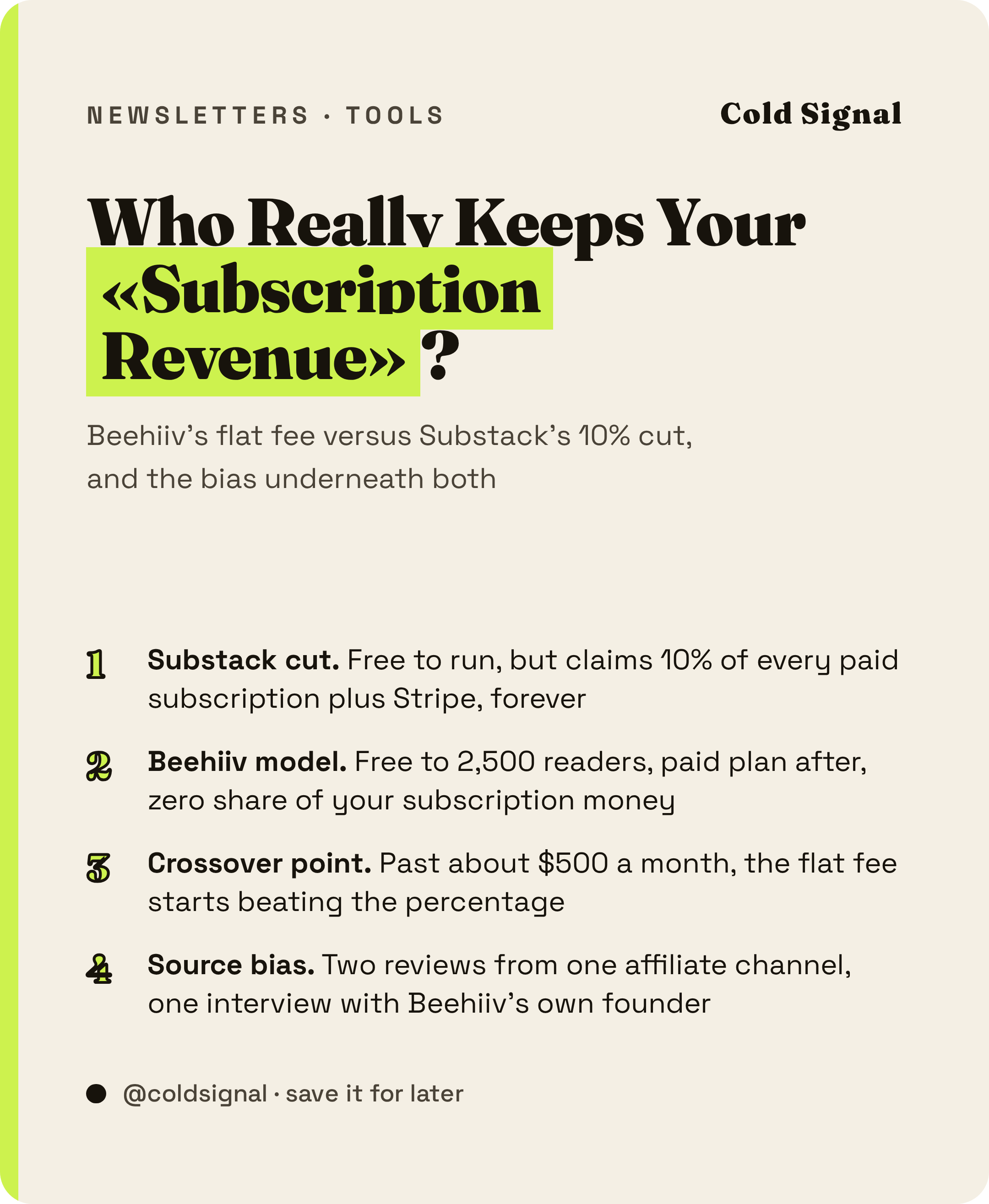
Substack charges nothing to open an account and nothing each month, even with a large list, by Savage Reviews' account. In exchange it claims ten percent of every paid subscription, plus Stripe processing, and that slice never expires. beehiiv runs the mirror image. Free up to 2,500 readers, then a paid plan kicks in, and once you charge for your newsletter the platform takes no share of that money. The same channel quoted that paid tier at $43 in its January video and around $49 by June, so check the live price before you commit.

What does the 10% actually cost once you scale?

The percentage feels trivial until the list grows. Savage Reviews walked through the arithmetic. At $500 a month the two roughly tie, since Substack's $50 cut lands near beehiiv's fixed bill. Above that the lines separate. At $1,000 a month Substack collects $100, at $2,000 it collects $200, while beehiiv's charge holds flat. The channel also cited one operator pulling $20,000 a month who said the cut and Stripe fees drained close to $6,000 every month, near $72,000 across a year. Read that as one creator's report, not a fixed rate every newsletter will hit.

Can you trust the reviews pushing this conclusion?

Here is the part the videos skate past. Both head-to-head comparisons come from one channel, Savage Reviews, which runs affiliate links and an Amazon referral pitch on every upload. The third source is a conversation with Tyler Denk, who founded beehiiv, on a podcast that opened by handing out a beehiiv discount code. All three tilt the same direction. None of them is an independent stress test of Substack's case. The fee logic holds up on its own, but no neutral voice in this batch argued the other side.

Which platform fits which kind of creator?

What you sell decides the winner. If you write and want readers quickly without an upfront bill, Substack's free door and built-in network do genuine work, and Savage Reviews put its reach at 35 million readers with 3 million paying. Denk made the opposite pitch, built on owning your distribution. He pointed to Morning Brew landing in 3 million inboxes each morning, and to Ben Thompson running Stratechery solo for about a decade on his own infrastructure, charging $12 to $14 a month now after starting near $10, and reportedly clearing $3 to $4 million a year on subscriptions alone. That story sells a business stack, which is what beehiiv markets.

Do this

FAQ

Does Substack really take 10% of paid subscriptions forever?

By Savage Reviews' account, Substack charges no monthly fee but keeps 10% of every paid subscription, plus Stripe processing, with no cap and no expiry. That cut scales with your revenue rather than flattening out. The figure comes from a single affiliate channel, so verify it on Substack's own pricing page before deciding.

How much does beehiiv cost and does it take a revenue cut?

beehiiv is free up to 2,500 readers, then moves you to a paid plan. The same channel listed that plan at $43 in January and around $49 by June, so confirm the current number. Once you monetize, beehiiv takes 0% of your subscription revenue, by both of its videos.

At what revenue does beehiiv become cheaper than Substack?

Savage Reviews put the crossover around $500 a month, where Substack's $50 cut sits close to beehiiv's flat fee. Above that the gap widens, since Substack scales with revenue while beehiiv stays fixed. At $2,000 a month the channel had Substack taking $200 against beehiiv's flat charge.

Is beehiiv better than Substack for a serious newsletter business?

On fee math alone, the flat model favors anyone earning past a few hundred dollars a month in subscriptions, which is the case these sources make. But all three sources lean toward beehiiv, including its own founder. Treat the conclusion as plausible and self-interested, then test it against your own numbers.

Should I pick Substack if I am a new writer with no audience?

Substack's free entry and reader network help when you are starting from zero, and Savage Reviews cited 35 million readers already browsing it. You pay for that reach later through the 10% cut once subscribers arrive. For a pure writer prioritizing discovery over fee efficiency, that trade can make sense.

Some links are affiliate links. We earn a commission if you subscribe, at no extra cost to you. It never changes our read of a tool.

Last updated 2026-06-21
Sources (3):
Related comparisons:
Cold Signal · Cold Signal synthesizes public video reviews from independent creators. Some links may be affiliate links; they never change our read of a tool.