Who actually buys a paid subscription when you launch?
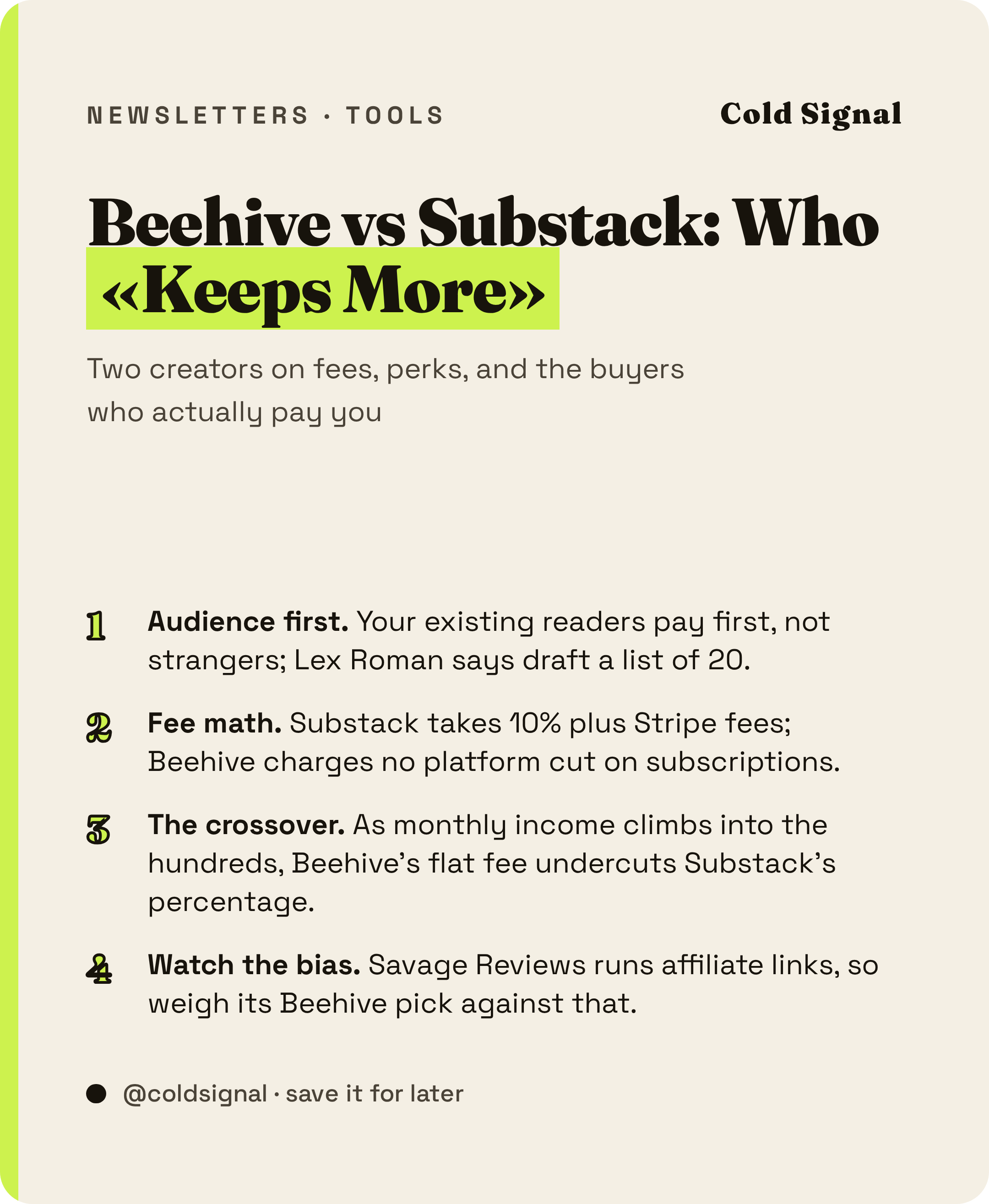
Lex Roman puts the platform debate last on purpose. Her starting point is the buyer. Strangers do not appear to fund a new paid tier. The first checks come from people who already follow your work: past clients, colleagues, podcast listeners, the readers who reply and share. She suggests writing down 20 names of people you think would pay, then building everything else around that short list.
From there she works backward through motivation. Some readers pay for access to you. Some pay to join a community you host. Others want behind-the-scenes intel, and a few just want the project to survive. Roman calls out a fallacy she thinks Substack and Patreon oversold: that people will pay simply because you are interesting. A handful will. Most need a concrete reason, so she has new subscribers tell her why they joined and treats those answers as data.
Substack or beehiiv: which one keeps more of your money?
This is where Savage Reviews does the arithmetic. Substack costs nothing to run, even at 100,000 subscribers, but it takes 10% of every paid subscription plus Stripe fees, with no end date. beehiiv is built the other way. It is free up to 2,500 subscribers, paid plans begin at $43 a month, and once you monetize there is no platform cut on subscription revenue.
The reviewer walks a sample writer through it. At $500 a month in subscriptions, Substack skims $50 while beehiiv's plan runs $43, so the two land close. At $1,000, Substack's slice doubles to $100 and beehiiv holds flat; at $2,000 it climbs to $200. Once monthly income reaches into the hundreds of dollars, the flat fee pulls ahead, and the channel says that gap keeps widening as revenue grows.
Reach and pedigree differ too. Substack launched in 2017 and now carries roughly 35 million subscriptions, about 3 million of them paying, with built-in discovery, notes, and a reader app. beehiiv arrived in 2021 from the Morning Brew team, who had grown that newsletter to 4 million subscribers, and it tilts toward growth tooling: custom domains, referral programs, deeper analytics, and an ad network. Savage Reviews notes that a major publisher, Time, has moved over.
What should you charge, and which perks earn it?
Roman ties price to three inputs. Look at competitors, and not only other paid newsletters; include memberships, PR platforms, and any alternative your readers already pay for, since the wider lens can justify a higher number. Weigh the real value of each perk, whether that is a monthly training or a one-on-one. Then factor in how often you ship. Publish daily and you can ask for more; deliver quarterly and you should sit below the field.
On perks she warns against stacking. Pick one or two anchors that match your top motivators rather than copying what everyone else lists. Her own examples are pointed: Seamus Hughes runs trainings on how he digs federal court records for CourtWatch, and Four Four Media offers a subscriber-only podcast feed about how its reporting and worker-owned business actually run. Community access tends to live in Discord, Slack, or Circle. Her advice on merch and mailed items is blunt: skip them early, because addresses, sizes, and international shipping turn into a drain you do not need.
Where do these reviews disagree, and who should you trust?
The two creators barely overlap, which is useful. Roman never recommends Substack and says so plainly, citing weak tooling and little control over tiers or subscriber communication. She also reads the broader market as cooling, with the 2020 and 2021 subscription rush settling and Substack losing some shine. Treat that as her stated opinion, not a settled fact, since the second source in our read does not test the same claim. Savage Reviews is gentler, granting Substack its simplicity and discovery for a pure writer.
One caution on the beehiiv verdict. Savage Reviews openly earns through affiliate links, including a product link in its description and a general Amazon link. That does not sink the fee math, which you can check, but it is reason to confirm current pricing yourself before committing. Roman has a stake too: she sells her own materials through Paid Newsletter Playbook. When a reviewer profits from your click or your purchase, lean on the numbers you can verify and discount the enthusiasm.