What does each platform actually charge?
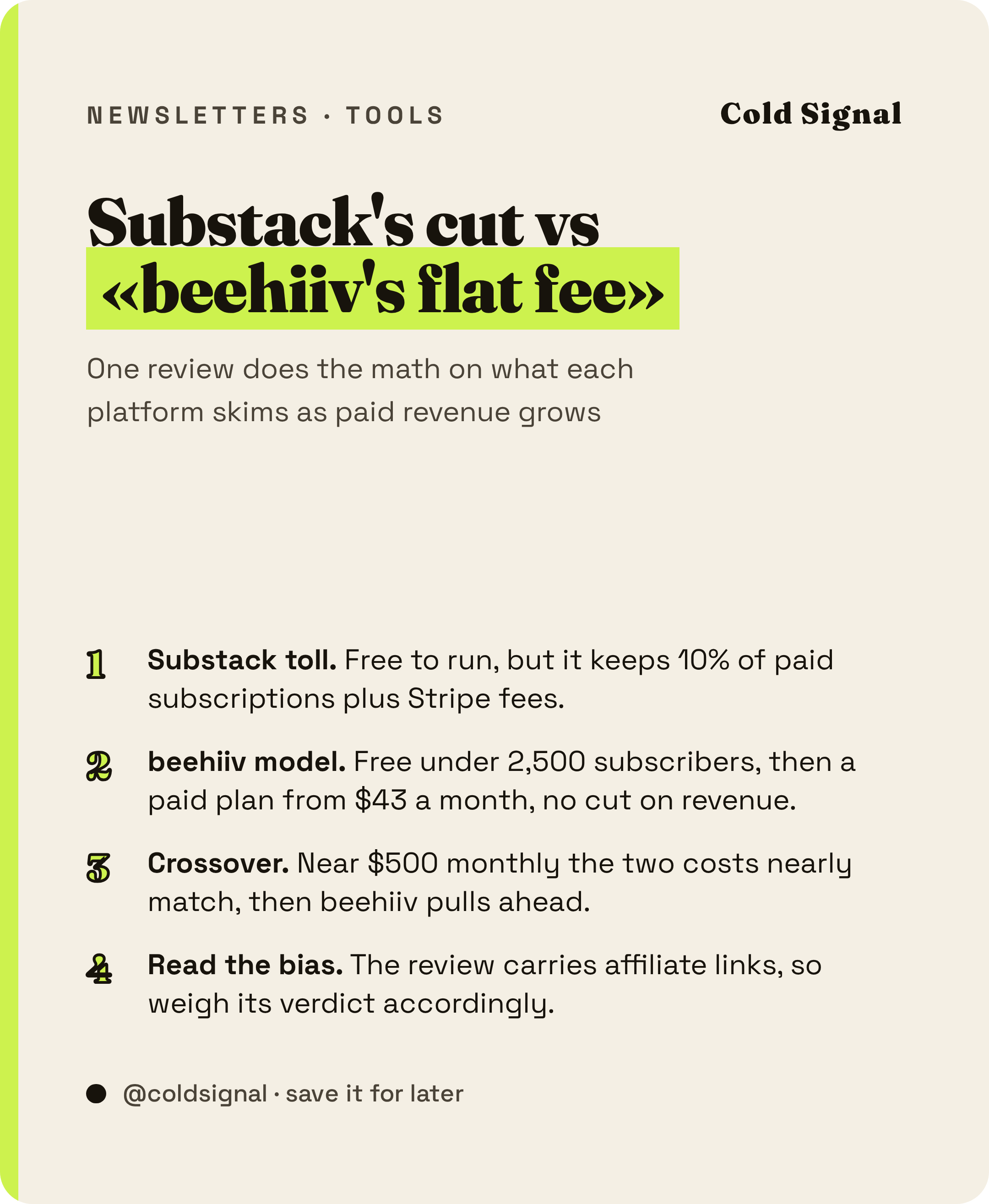
The two pricing models sit at opposite ends. Substack, launched in 2017, costs nothing monthly and stays free even at 100,000 subscribers, the review notes. The trade is a 10% slice of every paid subscription, plus Stripe's processing fees, with no expiry. beehiiv, built in 2021 by people from the Morning Brew team, runs free up to 2,500 subscribers. Past that, its scale plan starts at $43 a month.
Once you monetize on beehiiv, the platform takes no cut of subscription revenue, according to the same review. So the choice is structural, not cosmetic. Pay nothing up front and surrender a percentage of what you earn, or pay a fixed monthly bill and keep the rest. Which wins depends entirely on how much paid revenue you pull in.
At what revenue does beehiiv get cheaper than Substack?
The review walks through the arithmetic. Earn $500 a month from subscriptions and Substack's 10% comes to $50, while beehiiv's plan runs $43, close enough to call a tie. Push revenue to $1,000 and Substack's cut doubles to $100. At $2,000 it climbs to $200, and beehiiv's flat fee does not move.
That is the whole case in one line: a percentage scales with your income, a flat fee does not. Below the $500 range the difference barely registers, so a small newsletter feels no pinch on Substack. As paid revenue grows, the gap widens in beehiiv's favor, and the review says it keeps widening from there.
Which one should a writer pick, and which suits a business?
Use-case decides this. A solo writer who wants to publish fast and lean on built-in discovery has a real reason to stay on Substack, which the review frames around its reader network: it cites 35 million active subscriptions on the platform and 3 million people paying for content. For someone starting from zero, that audience and the simple setup carry weight.
An operator running multiple revenue streams gets a different answer. beehiiv leans toward growth tooling: custom domains, referral programs, analytics, and an ad network, per the review. The reviewer also points to publishers like Time moving over and to the platform passing its fifth year. Treat those as that creator's framing, since no second source here confirms them.
Can you trust a review that runs affiliate links?
Worth a flag before you act on any of this. The reviewer states outright that the description holds an affiliate link to one of the products, plus a general shopping link, both of which pay the channel when viewers buy. A reviewer who earns on a click has a quiet reason to nudge you toward the tool that pays.
The verdict still favors beehiiv for business users, and the underlying math checks out on its own terms. We read it as one creator's analysis, not a settled comparison. With a single video and an affiliate incentive in play, confirm the current pricing on each vendor's own page before you commit, since plans shift.